mirror of
https://github.com/akiradeveloper/msgpack-nim.git
synced 2026-01-02 07:24:42 +00:00
No description
|
|
||
|---|---|---|
| GenTests | ||
| .travis.yml | ||
| example.nim | ||
| gentest.rb | ||
| LICENSE | ||
| Makefile | ||
| msgpack.html | ||
| msgpack.nim | ||
| msgpack.nimble | ||
| overview.svg | ||
| README.md | ||
| stack.yaml | ||
| unwrapinto.nim | ||
| unwrappable.nim | ||


I will start this project once Nim compiler reaches 1.0
msgpack-nim
A MessagePack binding for Nim

API: https://rawgit.com/akiradeveloper/msgpack-nim/master/msgpack.html
msgpack-nim currently provides only the basic functionality.
Please see what's listed in Todo section. Compared to other language bindings, it's well-tested by
1000 auto-generated test cases by Haskell QuickCheck, which always runs
on every commit to Github repository. Please try make quickcheck on your local machine
to see what happens (It will take a bit while. Be patient). Have a nice packing!
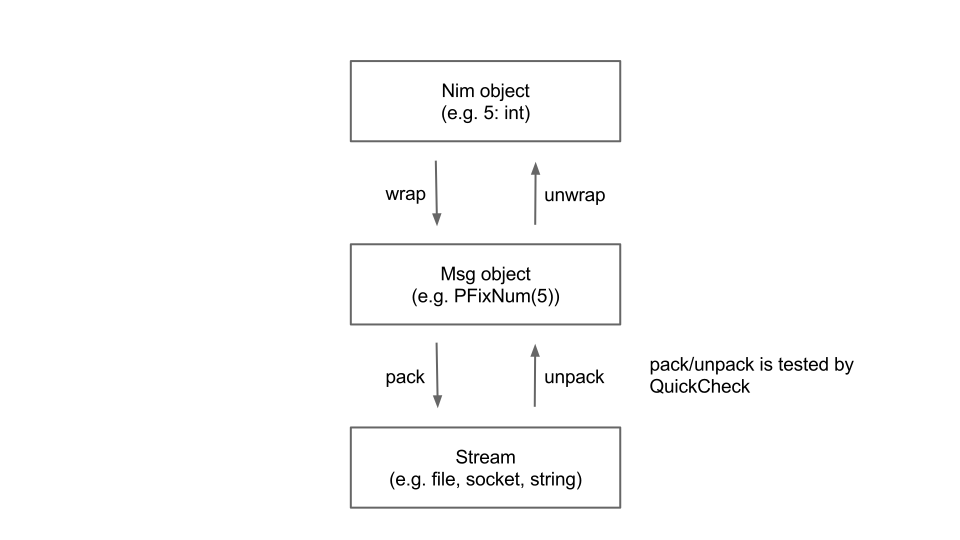
Install
$ nimble update
$ nimble install msgpack
Example
import msgpack
import streams

# You can use any stream subclasses to serialize/deserialize
# messages. e.g. FileStream
let st: Stream = newStringStream()

assert(st.getPosition == 0)

# Type checking protects you from making trivial mistakes.
# Now we pack {"a":[5,-3], "b":[1,2,3]} but more complex
# combination of any Msg types is allowed.
#
# In xs we can mix specific conversion (PFixNum) and generic
# conversion (unwrap).
let xs: Msg = wrap(@[PFixNum(5), (-3).wrap])
let ys: Msg = wrap(@[("a".wrap, xs.wrap), ("b".wrap, @[1, 2, 3].wrap)])
st.pack(ys.wrap) # Serialize!

# We need to reset the cursor to the beginning of the target
# byte sequence.
st.setPosition(0)

let msg = st.unpack # Deserialize!

# output:
# a
# 5
# -3
# b
# 1
# 2
# 3
for e in msg.unwrapMap:
  echo e.key.unwrapStr
  for e in e.val.unwrapArray:
    echo e.unwrapInt
Todo
- Implement unwrapInto to convert Msg object to Nim object handily
- Evaluate performance and scalability
- Talk with offical Ruby implementation
- Don't repeat yourself: The code now has too much duplications. Using templates?
Author
Akira Hayakawa (ruby.wktk@gmail.com)